Helmets.org
Bicycle Helmet Safety Institute
Consumer-funded, volunteer staff
| Helmets | Children | Promotions | Statistics | Search |
Chrono Bike Helmets for Time Trials
Summary: The Chrono (aero) style is a special aerodynamic helmet for time trialing. It is not suitable for street use. The tail can be a hazard in a crash. We have a list of individual models below the general explanation.
Chrono helmets are a very special type that is optimized for aerodynamics for use in time trials. The aero shape is advantageous at time trial speeds, primarily above 20 mph, so it is not of much use for ordinary street riding.
Early chrono models were shells only, and not certified for impact protection. Beginning in 2002, Louis Garneau introduced a chrono model certified to the US CPSC bicycle helmet standard. Two years later the European racing authorities required that chrono helmets used in time trials must meet the European EN 1078 bicycle helmet standard. That began a flurry of retrofitting as manufacturers tried to cram impact foam into their chrono shells. Depending on the amount of room available they were successful, but some had to redesign from scratch. Although they must sell very few of their chrono models, manufacturers believe that they lend prestige to the entire line.
The European CEN standard is less severe than the US CPSC bicycle helmet standard. Helmets built only to the CEN standard are less protective. One example of the difference is that CEN helmets are tested in 1.5 meter drops on the flat anvil, while a CPSC helmet has to perform at 2.0 meters. CEN helmets can be lighter and thinner, and usually are.
USA Cycling formerly accepted CEN helmets for races that it sanctions in the US, but reverted to a CPSC requirement starting January 1, 2010, as noted in the current USA Cycling Rule Book. In anticipation of that ruling and to sell in the US market, many manufacturers improved the protection of their chrono helmets.
The tail of a chrono helmet is not an asset for anything but aero shape. It is long and provides a great place to snag your head in a fall, twisting your head and neck. We don't recommend chrono helmets for street or trail use. Here is an email that demonstrates why:
"I was recently in a crash trying to avoid another rider during a triathlon. It was a typical fall with the bike sliding out in front of me and I landed sliding on my elbow, butt and head. This is generally not the most serious kind of crash but my comments are related to the helmet I was wearing, one of the time trial 'aero' helmets which are being used a lot more by triathletes. On my helmet the shell extends 5-6 inches past the head. The rear aero extensions were held intact by the plastic shell covering the helmet but the downward force from the back of my head broke the inner styrofoam shell into several pieces; the back retention clamp broke off; and the rear strap connection which did not go completely through the helmet (i.e. connected only to the styrofoam part of the helmet) also pulled out. With only the front ends of the chin straps attached to it the helmet came off my head."
Note that using a helmet like that in traffic, where the first hit is likely to be on a car, having the helmet come off could mean hitting the pavement with a bare head. In a time trial there is normally only one really hard impact, on the road. So the tail is a hazard. Here is the Snell Foundation's warning label, required on any helmet meeting their B-90TT or B-95TT standards for time trial helmets:
"WARNING: THIS HELMET IS NOT INTENDED FOR RECREATIONAL USE. This special use helmet has been designed to provide an aerodynamic benefit through an aerodynamic tail which in a fall or crash may reduce its ability to provide adequate protection. In a fall or crash the aerodynamic tail may cause the helmet to be pushed out of position thereby exposing the head to serious and/or fatal injury. Similarly, in a fall or crash a rider may be exposed to a strangulation and/or choking hazard from the retention system. USE ONLY ON A CLOSED DESIGNATED COURSE IN CONNECTION WITH SANCTIONED TIME TRIALING ACTIVITIES OR COMPETITIVE EVENTS."
That should be a caution to anybody considering the use of a long tail time trial helmet.
Riding in a chrono helmet is not simple if you want the full aero effect. Racers train in wind tunnels for best positioning because a degree or two of helmet tilt causes very large changes in wind resistance. If you have a long tail helmet, the tail must lie flat against your back for aerodynamics, so you can't tilt your head to look down at your computer or check your gears or relax your neck muscles without poking the tail up into the wind stream. Some riders use a humped over crouch, while others get down and flatten the back. If you have to stand on a hill you will lose the advantage unless you have practiced riding out of the saddle but bent over in a tuck. Those variables require a matching helmet shape for maximum efficiency.
The debate on long tail vs. short tail aero helmets continues. Casco opened it in 2009 with claims that their extremely round helmet performed better in actual riding, and there are many shorter helmets on the market now. If your head position is normally low, you may not need a long tail. Pros don't need them if a following car can give them a heads up before turns and they can keep the head down for most of a time trail. But racers with a higher head position and a need to see ahead may want to stick with a long tail model. Only a wind tunnel session can tell you for sure.
In 2013 a new category of aero helmet appeared: the aero road helmet. Not as slick as a chrono time trial helmet, but made more aerodynamic than a normal road helmet, often by covering the vents. Some have adjustable vents, or use vent covers. They are used by pros in some pack races, but abandoned for stages where ventilation becomes critical. They will not improve the average road rider's performance very much, but you might want one for the image, and some have the rounder, smoother profile that we recommend. We don't know if their performance for time trialing is comparable to other designs.
Can a dimpled surface that burbles air like a dimpled golf ball improve aerodynamics? Casco has used a section of six raised rubber dimples in the rear to lower air adhesion there. The Carrera Intruder has two panels of stippled material glued into indentations along the surface for a dimpled effect up the front, along the top and down part of the tail. The Lazer Tardiz has a dimpled rear section. Louis Garneau's Superleggera and Vorttice have a dimpled front section. So there is some indication that dimples can help, but no agreement on where they should be. And Garneau has a line of raised bumps behind their dimpled section across the crown that they say will accelerate the air and cause it to flow smoothly down the sides in the rear.
Vents are another question mark. Some helmets have none, or only in the rear. Some have small ones. And at the other end of the spectrum some have generous ones. The rider will generate heat in a maximum effort time trial. Is it worth giving up some aerodynamic advantage to cool the head? The answer may be different for different riders, since some give off more heat from the head than others. Lazer is the only one to claim that air taken in through the front vents exits at the rear and pushes the helmet forward. We would have to be convinced of that, since conventional wisdom has always been that maximum aerodynamics means no vents at all.
Any weights shown below are the manufacturers' claim. Accuracy is likely to vary, and there are size and accessory differences, so weighing the helmet yourself is the only way to be sure.
Chrono Helmet Models
Note: Some of these helmets are reserved for team use and are not available through retail channels. Some may even have been discontinued, since they do not appear in the company's annual catalog and it is difficult to track when a design is no longer produced.- BBB Tribase: a European CEN model with a medium long tail in back and four narrow adjustable vents. Fits
sizes 55 to 61 cm. Can be found for less than 100 euros.
- Bell Javelin: a long-tailed model with flexible side pieces to make it easier to get on and off and a
channeled liner with two front vents. Ring fit. Has a removable face shield. The tri-glides--side buckles--are fixed
and cannot be adjusted, but this is not a True Fit system helmet, so be sure to try it on before you buy. Try to yank
it off to see if it will work on your head. Retail is $200.
- Bell Meteor II: designed by adding foam under the Bell Meteor to meet the CEN standard, so it is limited in
size to 59 cm heads and does not meet the US CPSC standard and will not be available in the US market. Weighs 315
grams.
- Briko Chrono: introduced in 2016 to replace the older Chrono, with a very round and smooth exterior with
only a single rear vent, although the liner has vent holes. It is not inmolded but has a thin shell that extends below
the liner. Ring fit. Face shield. Fits 53 to 61cm heads. Meets the European EN 1078 and CPSC standards. Magnetic
buckle. Weight is advertised as 400g. Retail is $200.
- Carrera Intruder: classic teardrop shape but with two panels of stippled material glued into indentations on
the surface for a dimpled effect. Two top vents and a tiny vent on each side.
- Carrera TT Viper: a long-tail time trial helmet, with soft contours in the shell, no vents and a section
designed to lie flat on the shoulder. Replaced the Intruder in 2013.
-
Casco Warp-Sprint This German helmet is an almost perfectly round and smooth
track sprinter's helmet with an above-the-nose shield completing the rounding.
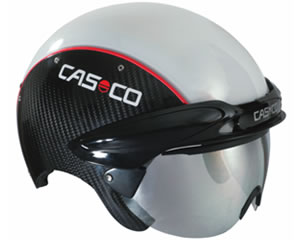
The shape is almost flawless for crashing. Casco claims it is equally flawless for aerodynamics "according to the latest findings of the automobile industry." This seems like a reaction to the aero tails that have set the fashion in chrono and other high end bicycle helmets for the last decade. Casco has used a section of six raised rubber dimples in the rear to lower air adhesion there. It has 12 tiny round vents that look like hollow rivets. It costs 248 Euros (300 with visor) and according to the CASCO site it is certified to the CPSC standard.
- Catlike Chrono Aero Plus: a long-tailed time trial helmet that meets the European standard. It is inmolded,
and has two small vents in front and rear. It fits 55 to 60 cm heads. It retails for $179.
- Catlike Mixino VD 2.0 the Catlight Mixino with a fixed outer shell covering the front and side vents to
permit it to qualify as a chrono helmet under UCI rules. Some front and rear vents are still open because Catlike
believes some venting improves performance on hot days. Retails for $320.
- Catlike Aero Chrono WT: a long-tailed time trial helmet that is certified by Catlike to meet the CPSC and
European standards. It is inmolded, and has one large vent in front and rear. The vents are in the shape of the Catlike
logo, probably not chosen for its aerodynamic qualities. Ring fit, for 54 to 60 cm heads. It retails in the US for $280
with visor.
- Catlike Rapid and Rapid Tri: new for 2016, a very round, smooth aero helmet with a shape similar to the
Casco. Has a face shield to complete the ball-shaped profile. Side/rear vents. The Tri version has two front vents for
longer rides or hotter weather. CPSC and European certified. Retail is $355.
- Cratoni Chrono: Short shell does not fully meet the shoulder or back. No vents. Certified only to the
European EN 1078 bike helmet standard, so can't be used in races sanctioned by USA Cycling. Weight is cited as 270
grams, if accurate very light for a chrono. Fits heads 54 to 60cm/21.3 to 23.6 inches.
- Cratoni C-Pace: classic chrono shape with "shoulders" in the back that taper to a very long downturned tail.
It has large front vents and smaller rear ones, six in all. It is inmolded and fits sizes 53 to 59 cm. Retails for 250
euros.
- Ekoi Chrono CXR11: a classic long tail time trial helmet, inmolded with a two small vents in front and a few
in the rear. Fits 56 to 60cm heads. Retail is 129 euros.
- Ekoi Chrono CXR12: a long tail time trial helmet, inmolded with many thin vents in front, sides and rear.
Might be a good one for a very very hot day, but the vents are likely to reduce aerodynamic performance. Fits 55 to
60cm heads. Retail is 149 euros.
- Louis Garneau P09: a 2013 chrono model representing another generation of Louis Garneau chrono models. It
has the traditional curved surfaces in front, but with Garneau's dimpled surface, sweeping back to a short tail. There
is one front vent, but it can be plugged. Garneau's marketing says they thinned the liner for a smaller front profile.
There is flip-up visor to avoid fogging in triathlon transition areas. Retail is $350.
- Louis Garneau P06: a chrono time trial helmet design from Louis Garneau, the first manufacturer to make a
chrono helmet that passed the CPSC standard. This one continued that tradition, and represents the fourth generation of
Louis Garneau chrono models. The Superleggera is dimpled like a golf ball in front for aerodynamics. Unlike most chrono
helmets it has large vents--two in front and three in the rear. It has a medium long tail. The shell is glued to the
liner, not molded. Garneau says the center of gravity has been adjusted to reduce neck fatigue and make it easier to
maintain an aero position. It fits 52 to 62 cm heads. Retail is $180, with an additional $45 for the Rocket Case and
$35 for the windscreen.
- Louis Garneau Windscreen: Not a helmet, but an accessory, this is a polycarbonate lens that wraps around a
helmet--almost any helmet--and is held on by hook and loop. It fits all of the LG chrono models. Comes in clear, smoked
or contrast-enhancing yellow. The edges are unprotected except at the nose, and you could probably slice meat with
them, even if it did not shatter in a crash. We would favor something with protected edges, like a pair of glasses or
goggles. Retail is $35.
- Giant Pursuit: new for 2017, a unique blend of aero and huge front vents that produces a strikingly
different design. The profile looks like a short-tailed chrono helmet with the tail missing and a slight upturn at the
rear. Retail is $230.
- Giant Rivet TT: introduced in 2016, a short-tailed chrono time trial helmet with round front vents and flat
surfaces on the top rear. The ladies version is the LIV Attacca TT. Retail is $230.
- Giro Aerohead Ultimate MIPS: new for 2017, a short-tailed time trial model that Giro says they designed with
wind tunnel averaging to reduce the usual sensitivity to minute changes in rider position. The textured shell is
carbon, and the liner foam is low density, a desirable feature even on a helmet that may never be crashed. The shell
shape is unusual, with a notch to provide ear clearance. No external vents, relying instead on internal vents in the
liner and air intake at the front edge. The MIPS layer extends down almost to the lower edge. There is a wraparound eye
shield made by Zeiss. Retail is $500. Also available as the Aerohead MIPS with a standard polycarbonate shell
that has four small exterior vents for $250. The shape is the same, and Giro markets the two as a choice between more
aero or better ventilation.
- Giro Air Attack Shield: Giro has taken a page from Casco's book and produced an aero helmet that is almost
as round and smooth as the Casco Warp. It even has an eye shield to extend the roundness down on the face. The Giro has
more vents than the Casco, and lacks the golf ball dimpled surface. It is a thin-shell rather than a hard shell. Also
comes as the Air Attack without the shield. Both are listed among Giro's aero helmets, but for most climates
they should be rideable on the street in three seasons even with the modest vents. Available in the spring of 2013 at
$200 and $240 retail.
- Giro Advantage II: A 2007 design and a welcome addition to Giro's lineup, their first chrono time trial
helmet meeting the US CPSC standard. (Giro's previous Advantage model had been sold only in Europe.) inmolded with five
small slit vents and the usual long chrono tail, open underneath. Retails for $165 but we have seen it discounted on
the web for as little as $100.
- Giro Selector: Giro's newer chrono model with no front vents, small rear vents and a shorter tail. Giro says
it accommodates new time trial positions and off center yaw better than the long tail models. There is a removable
piece that attaches to the bottom of the tail to extend it downward if that configuration is needed to close a gap to
reach the rider's shoulders. It retails for $275 with face shield. Giro has other models sold in Europe for use where
CEN helmets are required. Those may not meet the US CPSC standard.
- Gray Aerodrome: Synergy Sport has one helmet in their Gray line for triathletes. It is inmolded with the
long teardrop shape of the classic chrono, with six small slit vents in the front and partially recessed strap anchors.
It has soft "wings" on the sides. Strap junctions do not hold well. It is CPSC certified and comes in one size. It
retails for $150. Synergy Sport has a "Life Time Crash Replacement Warranty" and the consumer can return a crashed
helmet for a free replacement.
- GUB-Air: GUB Bike International is a Chinese company with a full line of bicycles and accessories. They
distribute a number of brands, including their own GUB helmets. Their chrono model is a long tail helmet with small
vents in front and top. It is inmolded and fits head sizes from 57 to 62 cm. We don't know their retail pricing.
- Kask TT: a long tailed model with face shield and tiny slit vents in front. Leather strap with fixed side
junctions. Meets the CPSC standard for the US market.
- Kask Bambino Pro: a chrono helmet in the Casco style that is almost as round and smooth as any helmet in the
world, with just a hint of oval in the shape. Inmolded with a thin shell. There is a face shield that completes the
round profile. Thin "micro vents" with chancels underneath provide some air flow. Has a magnetic visor mount. Meets the
CPSC standard for sale in the US. Retail is $500.
- KED Zeitfahren/Time Trial: KED's chrono model comes in long and short versions. The short version is called
the Track and looks like a regular bike helmet but is smooth-skinned with no vents except in the rear. The long
version is the Time Trial and has a long tail extending to the rider's back and covering the vents. Both have
CEN and CPSC certification.
- LAS Chrono: time-trial aero helmet with a polycarbonate shell, no front vents and an integrated clear
partial front face shield. Very long tail to reach the rider's back, with a slight shoulder hump. Certified to both the
CPSC and CEN standards. Ring fit for 54 to 61 cm (21.3 to 24.0 inches) heads. Retail is $240.
- LAS CXT: a very round, smooth helmet with tiny rear vents and a face shield. For pursuit and time trial
riding, this is the response to Casco's Warp with a shape that drops the long tail that most riders don't keep tucked
against their back.
- Lazer Wasp: new for 2013, a chrono-shaped helmet with a long tail and four narrow vents. Inmolded. The
bulbous front and tapering, descending rear sections are emphasized in the Fluo Black neon and black model with rings
that imitate a wasp. The name is less obvious in the plain black or plain white models, and Lazer says it stands for
Watt Saving Performance. Detachable sections, since it fits so closely that the rider puts it on in sections with
helmet first, then snapping on sides and adding the tail. Ring fit. Retail is $400.
- Lazer Wasp Air: Lazer cut the tail off the Wasp and made a rounded, smooth sided, short-tailed chrono helmet
retailing for $300 with face shield.
- Lazer Tardiz: originally named for Dr. Who's time machine, but the s at the end had to become a z. A chrono
model with front vents and a unique water intake used to replenish an evaporative cooling system. Dual shell enables a
dimpled rear section. Air taken in through the front vents is said by the Lazer catalog to exit the rear and push the
helmet forward. The only chrono model we have seen with a women's graphic version, called the Ldy Tardiz. Retail
is $160.
- Limar Speed King: introduced in 2009, a CPSC certified chrono inmolded with 6 long thin vents in the front
and 9 elsewhere for a total of 15. Limar says they offer good ventilation "without affecting the aerodynamics." It has
a flexible ear flap to avoid the chafing problem Ring fit for heads 54 to 61 cm. There is a carbon version, but that
refers to the black color, not the shell material. Retail is $190.
- Limar Chrono 05: an aerodynamic pursuit and time trial helmet with CPSC certification. Inmolded with 5 small
vents in the rear recessed into channels. Face shield optional. Limar says the short shape permits more efficient bike
position and works better when the rider is out of aero position or standing. Ring fit for heads 53 to 59 cm. Retails
for $170.
- Limar Superchrono: Limar's CEN-only chrono with ring fit system and a taped on shell has two large front
vents. Not for the US market. Pricing is described as "affordable." We don't know if this one is in production any
longer.
- Limar 007: a chrono helmet inmolded with 6 small vents. Ring fit for heads 54 to 61 cm. More elongated than
the Speed King and cut a little higher on the sides. Retail is $239.
- MET Drone wide body: with an aircraft-inspired name, this one is a chrono helmet with long tail. Inmolded.
European standards only, so not available in the US market.
- OGK/Kabuto: chrono model with Asian Fit.
- POC Cerebel: a 2015 aero road helmet, looking like a very short tail chrono model with a round front and no
vents. With integrated face shield it will retail for $350.
- POC Tempor: introduced in 2012, a unique chrono model that flares out on the lower sides and has a long tail
that fits snugly to the neck and rises to curve over the shoulders. The object is to treat the cyclist as one body mass
rather than a separate head and body.
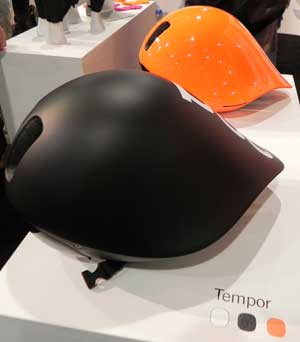 Has two big vents in the
front, and two small rectangular vents in the rear, but there are hints that "the vents might not be what you think
they are." Comes in neon orange, black and white. Retail is $380.
Has two big vents in the
front, and two small rectangular vents in the rear, but there are hints that "the vents might not be what you think
they are." Comes in neon orange, black and white. Retail is $380.
- Rudy Project Wing57: a 2014 chrono model designed by John Cobb with short tail, vents and an optional face
shield. Comes with a magnetic piece to add length to the tail and a tab resting on the shoulder of those with flat
backs that lets the rider raise and lower the rear of the helmet to achieve that critical angle that yields best aero
performance for different rider back profiles. The side vents have a role in reducing airflow disruptions. Has inserts
for the vents to close them or reduce their intake and improve aero performance for specific events and air
temperatures. The dorsal ridge along the top is to help in cross winds while maintaining a low front profile. Retail is
€300.
- Rudy Project Wingspan: A chrono model with more vents than most, a face shield and a split tail. Inmolded.
There are unique pieces on the sides that extend down to about the cheekbones, called "bionic wings." Medium length
tail does not get all the way down to the shoulder, and is said to be designed to maintain aerodynamics for riders who
sometimes look down or to the side. Comes with mesh or solid plugs for the front vents. Ring fit with one shell size to
fit 54 to 59 cm (21.25 to 23.2 inch) heads. This is Erik Zabel's time trial helmet. Comes in red, white and blue as
well as white. CPSC certification. Retails for $350. The black special edition Diamond model with Swarovsky crystal
highlights is $500.
- Rudy Project Syton Supercomp: another chrono model with the split tail, but with small vents, no side pieces
or face shield. Two shell sizes fit 54 to 62 cm (21.25 to 24.4 inch) heads. This one retails for $225.
- Scott TTS: a long tailed model with three small vents in front and side pieces with vents in them. Inmolded.
Meets only the CEN standard, so can't be used in races sanctioned by USA Cycling. Fits sizes 54 to 61 cm. (21.3 to 24.0
inches). Retail is 150 British pounds, about $230.
- Scott Split: a compact model with integrated face shield. Flexible side pieces around the face to facilitate
putting it on. No vent holes visible, but there are vent slots at the top of the face shield linking to internal
channels and slits at the rear. The strap adjustors hold reasonably well. Retail is $250.
- Selev Tempo: long tailed model with a full lower cover that comes all the way down to the neck. Vents, with
some lines sculpted in the shell rather than a completely smooth profile. Certified only to the CEN standard, so can't
be used in races sanctioned by USA Cycling. Has an internal radio wire channel. Fits sizes 54 to 59 cm. (21.6 to 23.2
inches).
- Selev TT Evo: a compact aero road helmet made for track racing. It has two small front vents. Sidepieces
come down the cheek in chrono style.
- SH+ Turbolence: a short-tail for time trialing with a rounded profile and two small steps in front that are
echoed on the sides. Tiny vents over the top and rear tie into an internal vent channel under the shell. Has an
integrated face shield. Certified only to the EN1078 standard, so not available in the US. Ring fit for heads from 55
to 58cm. Comes in black or white for €160.
- SH+ Eolus: has a round profile similar to the Casco Warp except for a slightly flattened rear. Has only tiny
vents in the rear. Ring fit. Comes with mirror and clear integrated face shields. Fits heads 55 to 60cm. Certified to
the CPSC bike helmet standard as well as CEN, and is available in the US for $360. With small vents it is the
Tri-Eolus.
- Smith TT Podium: new for spring of 2017, Smith's first chrono/time trial design. It is very round and smooth
with some elongation but no tail. There are very small vents in the front and around the face shield, but much larger
exhaust vents in the rear backed by a section of Koroyd straws in the Koroyd/EPS combination liner. It has MIPS, with
an extensive MIPS cage. The face shield is magnetically attached and is a new type that Smith says enhances detail
vision and color rendition. Fits heads from 55 to 62cm. Retail is $350.
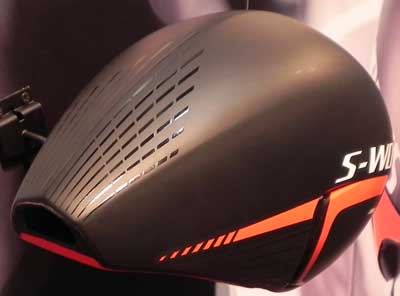
- Specialized S-Works TT: a long tail chrono model. Has one large brow vent in the front in Specialized style,
and four large rear vents on the tail. The tail is open underneath. Has non-stretching straps. Two sizes fit 52 to 61
cm (20.5 to 24") heads. At present this is the only model certified to Snell's B-90TT helmet standard, permitting long
tails but requiring a special warning label (see above). Retail is $300. Specialized has other chrono models not
available through retail, and sometimes only CEN certified for European racing. They include the TT1, TT3
and TT4. The TT4 has aerodynamics technology contributed by McLaren. It is a very expensive limited edition
model with multiple narrow "gill" vents on the sides that Specialized says improve the aerodynamics.
- Spiuk Aizea: a chrono and tri helmet. It is inmolded, and comes with two interchangeable tail pieces of
different lengths. There are long thin front vents that can be closed with a screen, and a face shield held on with
magnets. Meets the CPSC standard for sale in the US.
- Spiuk Kronos: a time trial teardrop shape with two small front vents and a center rear vent through the long
tail. Inmolded. Ring fit. Meets the US CPSC bicycle helmet standard. Retail is $235.
- Suomy GT-R: a long tail chrono model with the normal teardrop profile and vents that push air into internal
channels. Inmolded. Comes with a face shield. Fits 54 to 61cm heads. Retail is $300
- Sweet Protection Redeemer 2Vi: This unusual model has flared shoulders and a straight back, giving it a dramatically different profile from other chrono helmets. The company says the flared sides smooth the airflow over the riders shoulders and body, reducing drag. A vent in the top is said to allow some of the air build-up in front of the helmet to bleed through the helmet's interior, reducing its pressure. It has MIPS. Now on the heads of the Uno-X team who helped develop the design, available probably in the fall of 2023 at $480 retail.
- Uvex Aero: a long-tailed model with many ribs on the surface and four adjustable long skinny vents in the
front. Inmolded, with vent adjustors added later. Meets the CPSC standard. Comes only in white/silver. Fits heads 58 to
62 cm. Retails for $190.
- Uvex Race 2 Pro: a long tail design with integrated face shield. It has an Acoustic Warning System that hums
when it is off-center to alert the rider to less-than-ideal aero performance. Meets the European EN 1078 standard but
not CPSC, so can't be used in races sanctioned by USA Cycling. Retails for €200.
-
Uvex Factory Pilot 3 fp3 Time Trial: recalled in December 2014.
- Uvex Race 2 Pro: an inmolded long tail time trial/chrono model with four small triangular vents. An audible
signal helps the rider maintain optimal helmet position. Fits heads from 54 to 59cm. European model certified only to
the CEN standard. Retail is €200.
- Vittoria VHTT Chrono: introduced in 2016, a long tailed time-trialing helmet with small slit vents. Inmolded. Meets the CPSC standard for sale in the US. Fits heads from 55 to 61 cm.